
Dallas Probate Litigation Attorney
 Probate litigation becomes necessary when disputes arise during the administration of someone’s estate. This can happen for a number of reasons, such as a stakeholder challenging the validity of a will or accusing the executor of neglecting their responsibilities. To successfully navigate these disputes, contact a Dallas probate litigation lawyer. They can assess the root causes of certain conflicts and develop a strategy to resolve them.
At Ford + Bergner LLP, we have spent years guiding clients through the complexities of probate litigation. Whether someone is contesting a will or needs assistance handling a dispute between two beneficiaries, our team of Dallas contested probate attorneys can provide personalized attention and a tailored legal strategy to meet the unique needs of each client.
Contact us today at 713-597-5351 to seek a resolution while minimizing unnecessary legal burdens.
What Are the Most Common Events That Trigger Probate Litigation?
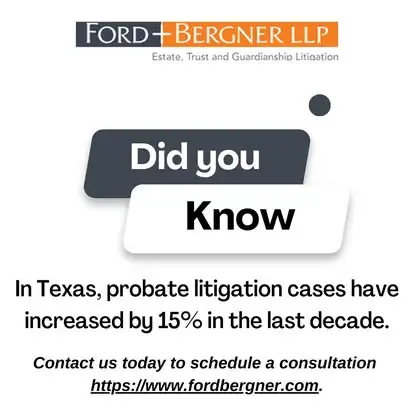
The goal of the probate process is to distribute all the assets in an estate exactly as intended. However, many different circumstances can raise conflicts among fellow stakeholders, and these require legal intervention to fix. Understanding the most common triggers for probate litigation can help individuals better anticipate and navigate their own possible challenges when managing an estate.
Some of the most common events that require probate litigation include:
- Contesting a will
- Disputes between heirs and beneficiaries
- Executor misconduct
- Lack of a will
Will Contests
A will contest happens when someone involved in the estate challenges the validity of the deceased person’s will. This happens for many reasons; for example, the person who created the will may have been mentally unstable when formulating the document, so they were not clear on what they were agreeing to.
Close relatives might also contest a will if:
- The deceased individual may have been coerced by someone looking to unlawfully benefit from the estate.
- Some portions of the will may have been forged.
Whenever someone has these suspicions, they should raise their concerns in probate court for a thorough examination. Depending on what the court finds to be true, the will can either be upheld based on its original terms or be invalidated completely.
Disputes Between Heirs and Beneficiaries
It’s not uncommon for disputes to exist between heirs and beneficiaries of an estate. Even when a will exists and everyone agrees on the terms’ legitimacy, disputes can still arise over how someone is distributing the assets. For example, some heirs might feel as if they were unjustly excluded from certain assets that are rightfully theirs. Sometimes, favoritism or personal grudges can bleed into these decisions and cause someone to act unethically in the process.
Even without any act of alleged malice, two beneficiaries might simply disagree on how certain terms in a will should be interpreted. When this happens, these parties can bring their disagreement to the probate court, seeking clarity on the deceased individual’s true intentions. The court will look into all estate documents as written to decide how the document should be interpreted and honored.
Executor Misconduct
An appointed executor has several important tasks. They are required to work on behalf of the estate plan’s owner to settle debts, distribute remaining assets, and honor every detail of their will. Unfortunately, executors can act negligently or unlawfully. For example, a beneficiary might accuse an executor of improperly handling estate assets or making decisions that are in their interest rather than that of the beneficiaries.
Whenever an executor is guilty of misconduct, the beneficiaries have the authority to take legal action. As part of the probate litigation process, the court will review how an executor has been behaving and whether their actions align with the interests of the deceased individual. If the allegations of misconduct are true, the court has the authority to remove the executor from their role and appoint a replacement to protect the integrity of the estate.
Lack of a Will
 Whenever someone passes away before they can create their own will in Texas, their estates will be processed under the state’s intestacy laws. These will dictate exactly how the estate will be dealt with in the absence of instructions from the individual who passed away. Because these decisions are not being made by the individual or a close relative, surviving family members may disagree on how the estate should be divided.
For example, if the individual who passed away has children from multiple marriages, it can be difficult to determine who has a right to what specific portions of an estate. Tensions can run high among the surviving family members, who might all have a different opinion on what their deceased relative would have wanted. As part of the intestacy process, the court will interpret and apply state laws to determine the rightful heirs of the estate.
How Can a Contested Probate Attorney in Dallas Help?
When facing disputes in the probate process, enlisting the services of a contested probate attorney in Dallas provides invaluable legal experience. A knowledgeable probate attorney can bridge any gaps in your understanding of this complex area of law, helping to prevent costly mistakes and ensuring a smoother resolution to your case.
Legal Guidance in Will Contests
Whenever the validity of a will is challenged, it can completely stop the probate process from advancing. This can lead to varying levels of legal battles, that an attorney can help resolve so the case can move forward. A probate attorney can:
- Assess mental capacity. A contested probate attorney in Dallas, typically with the assistance of a medical professional like a forensic psychiatrist or psychologist, can evaluate whether the creator of the will was of sound mind when they did so. This is a critical step when determining whether the will was created under valid conditions.
- Identify undue influence. A skilled probate attorney can see if there are signs that someone pressured or manipulated the individual when they created their will.
- Review execution procedures. A Dallas contested probate attorney can check whether the will was executed compliantly under Texas law. For example, the will must be signed in front of a valid witness.
Safeguarding Against Executor Misconduct
All executors share an important role in managing an estate and protecting the interests of all heirs and beneficiaries. Unfortunately, these individuals are sometimes found guilty of engaging in fraudulent activity. A probate attorney can address this by:
- Investigating financial management. A Dallas contested probate attorney can review how an executor handled the assets in the estate they were responsible for. This includes looking into how they managed expenses and who they made payments to. A lawyer can search for these and other evidence of financial mismanagement.
- Filing for executor removal. If a probate attorney can prove how an executor engaged in unlawful activity, they can start the process of appointing someone new. As part of this process, they will scrutinize the background of the new individual before allowing them to replace the original executor.
- Ensuring compliance with fiduciary duties. Attorneys can review all executor activity to see if every decision made was in the interest of the beneficiaries and heirs. All their accounting activity and asset management must be transparent and properly communicated to relevant stakeholders of the estate.
Navigating Complex Texas Probate Laws
To successfully manage an estate, it’s important to understand the specific probate laws in Texas. A probate attorney can help you do so by:
- Explaining intestacy laws. In estate cases where a valid will does not exist, an attorney will explain how assets will be distributed through the state’s intestacy laws. In general, these laws prioritize close relatives, like spouses and children.
- Manage required filings. An attorney can review every required legal document, like a petition and motion, and then file them correctly before their deadlines. This is critical, as it can prevent the probate process from being unnecessarily delayed.
- Representing clients in court. If probate litigation is necessary, an attorney can represent their client’s interests. They can help them contest or defend a will or resolve a new dispute over how the estate is being managed.
Contact Ford + Bergner LLP Today
If you find yourself struggling to navigate an active probate dispute, connect with a Dallas contested probate attorney at Ford + Bergner LLP as soon as you can. Our custom legal strategies and personalized approach can help expedite the probate litigation process and honor all aspects of an estate. Contact us today at 713-597-5351.
FAQs
Q: Can a Probate Attorney Help If the Deceased Had Significant Debt?
A: Yes, a probate attorney can be of service in managing an estate that comes with significant debt. Texas allows creditors to make claims against an estate during the probate process to collect funds that should be paid to their organizations. In these instances, a Dallas probate litigation lawyer can review all outstanding debts to determine their validity. If they are, all such eligible creditors can then be rightfully paid.
Q: How Does Probate Litigation Impact the Timeline for Distributing Assets?
A: Probate litigation can significantly extend the timeline of an estate case. This is mostly true in instances where a will is contested or major disputes are preventing heirs and beneficiaries from moving the case forward. If all parties cannot reach a mutually agreed-upon solution through negotiation or mediation, probate litigation becomes inevitable. However, the extra time spent in probate litigation can be worth it to properly handle the estate.
Q: What Happens If an Estate Includes Business Interests?
A: If business interests are part of an estate, like a family business or small company owned by the individual who passed away, the probate process can become more complicated. In these moments, an attorney can evaluate the business and determine what legal steps are necessary to transfer the ownership of the business. Probate litigation may be necessary if there is a disagreement between stakeholders on the future of the business or the division of its assets.
Additional Resources
What Are Common Grounds for Probate Litigation in Houston?
Having an Executor Removed Isn’t Always a Simple Undertaking
What Does Texas Law Say About Executor Compensation?
Pursuing Probate Litigation Against the Estate Administrator
Heir Woes: Can Creditor Claims Exhaust All Probate Estate Assets?
Time Is Of The Essence With Probate Disputes
What is Undue Influence, and How Can You Prove It?
3 Steps to Take Before Selling Real Estate in Probate Proceedings
Ford + Bergner LLP
Trusted Probate And
Estate Planning Solutions
How Can We Help?
Fields marked with an * are required

Follow Us On
Connect With Us
Connect With Us
© 2026 Ford + Bergner LLP. All Rights Reserved.
